The Lumatic Lab Style Matcher, recently released by our sister site photoedithelp, is a sophisticated image processing utility designed for tonal and color distribution transfers.
It should not be confused with basic color overlays, so often shown as ‘night scope’ colouring, this engine employs histogram matching and cumulative distribution function mapping to align the “tonal DNA” of a reference style with a target photograph while preserving original details.
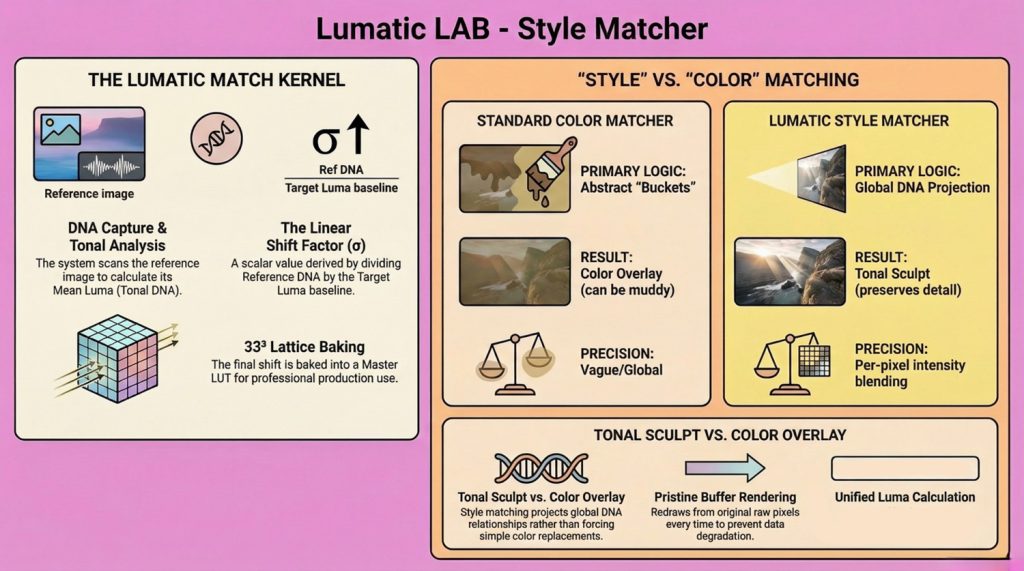
The difference between a standard Color Matcher and the Lumatic Lab Style Matcher lies in their fundamental approach to modifying an image’s underlying structure:
- Primary Goal: A standard Color Matcher attempts to force “Color A to become Color B,” whereas the Style Matcher focuses on “Projecting Tonal Relationships”.
- Logic and Precision: Standard color matchers rely on abstract tonal “buckets” (like Shadows, Midtones, and Highlights) to apply a vague, global “Look” over an image. The Style Matcher instead uses “Global DNA Projection” with per-pixel intensity blending to integrate a “Tonal Sculpt” directly into the image’s pixels.
- Handling of Luminance: Standard color matching often ignores an image’s underlying luminance, which can result in “muddy” highlights or “crushed” shadows.
- Tonal Re-mapping vs. Replacement: Ultimately, Style Matching is about re-mapping the distribution of light and color, rather than performing a pixel-for-pixel replacement. It acts like a “Color Grade” that preserves an image’s detail, as opposed to a “Color Overlay” that destroys it.
An abbreviated ‘Quick Start Guide’ is available here in PDF format and more details here.